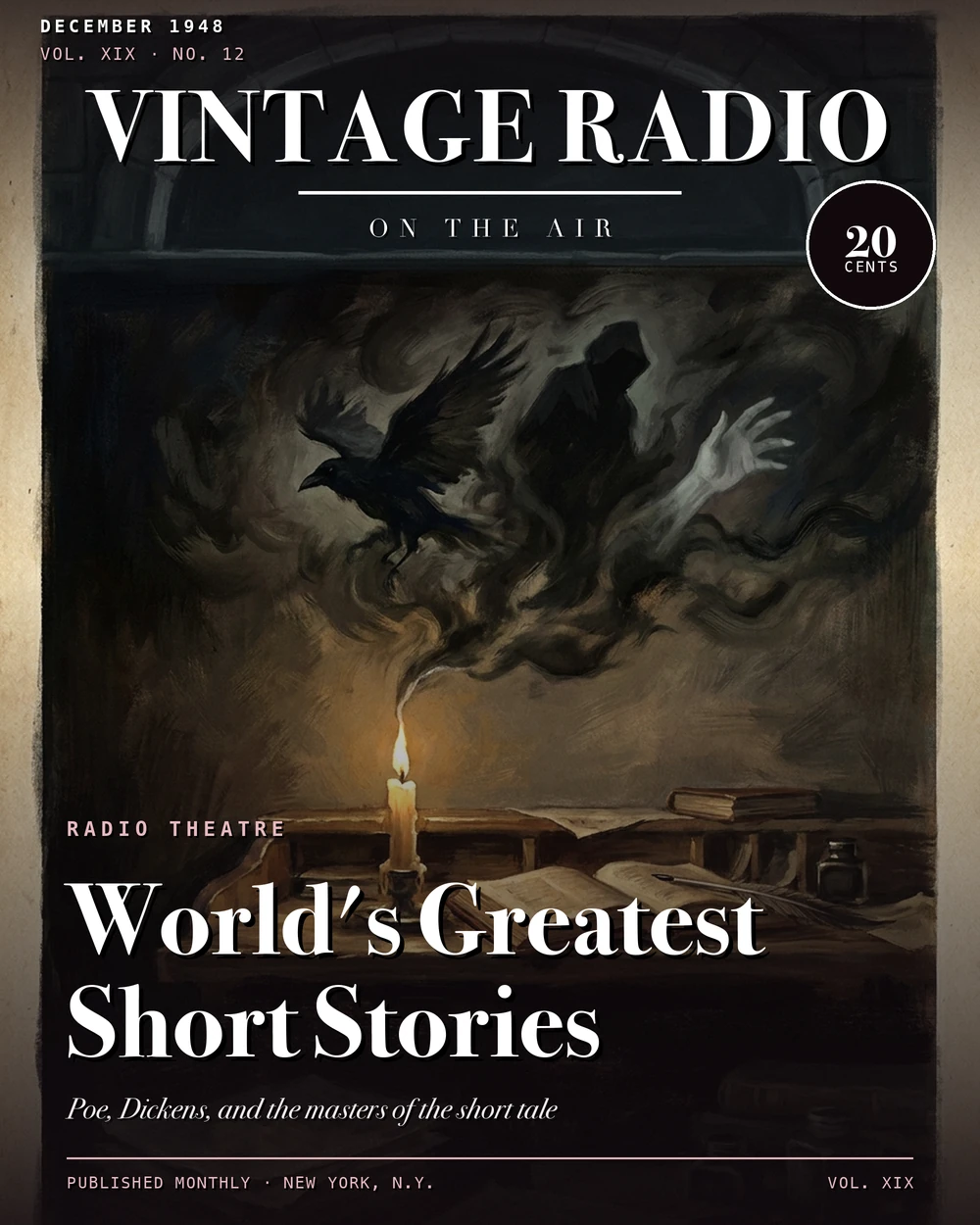
World's Greatest Short Stories
The Man Behind the Microphone
What set World's Greatest Short Stories apart from other literary anthology programs wasn't the material — it was the voice. Nelson Olmsted, born Leroy Nelson Olmsted Jr. in Minneapolis in 1914, didn't perform short stories so much as inhabit them. His approach was described at the time as "an expressive monotone," which sounds like a contradiction until you understand what it meant in practice: rather than leaping between broad, distinct character voices, Olmsted shifted between characters with subtle changes in inflection, keeping you inside the story's spell without ever breaking it.
Olmsted had been building toward this kind of work for years before NBC came calling. At WBAP in Fort Worth, Texas, starting in 1939, he developed his signature method of reading literature aloud on the air. Before that, he hosted a horror program called Black Night at the same station from 1937 to 1939 — a show that drew fan mail from listeners across ten states. That kind of reach out of a regional station was hard to ignore, and NBC didn't. World's Greatest Short Stories was his first major network assignment, and it launched what would become a decade-long run as NBC's resident storyteller.
How the Show Worked
World's Greatest Short Stories aired on Sunday nights at 10:00 PM on NBC, a slot that suited the program's unhurried, literary character. The premise was simple, and the announcer's tagline said it plainly: these were "those stories that constitute our rich heritage of excellent entertainment all blessed with a touch of genius" — the classic short stories that listeners had always promised themselves they would read. The show made good on that promise for them.
The catalog of authors and titles the series drew from was broad. Poe's "The Tell-Tale Heart," Dickens's "The Pickwick Papers," and "The Little Wife" were among the dramatized works. Olmsted served as performer and narrator throughout, carrying each story largely on his own rather than relying on a full cast of actors trading lines. That format kept the productions intimate — more like being read to by someone who knew the material cold than watching a stage play through a radio speaker.
The show's initial run is documented in 1939 and 1940, with later production periods noted in 1944 and 1947. Whether these later iterations represented revival broadcasts, new productions, or repackaged material isn't entirely clear from surviving records, but the program's presence across nearly a decade points to sustained interest in what Olmsted was doing.
What Came Before and After
World's Greatest Short Stories didn't arrive in a vacuum, and Olmsted didn't stop with it. The NBC landscape of the late 1930s and 1940s included several literature-anthology Drama programs running at roughly the same time — Author's Playhouse, Favorite Story, NBC University Theater, and the companion series World's Greatest Novels among them. The short-story format had its own specific appeal within that group, since a half-hour broadcast could contain a complete story rather than an abridged novel, giving the program a natural completeness that longer adaptations sometimes lacked.
After World's Greatest Short Stories, Olmsted moved directly into Dramas by Olmsted, which ran from 1940 to 1941, and continued in the NBC storyteller role through the decade in various formats. The foundation for all of it was the work he did on this series — finding out, in practice, what it meant to hold a radio audience through prose fiction rather than drama built specifically for the medium.
What Survives
Sixteen episodes of the series are in the catalog here. Counts vary across different collections — some sources note 18 recordings in circulation, others reference 12 — which reflects the uneven way surviving recordings have been catalogued over the years rather than any definitive tally of what was originally broadcast. What's consistent across sources is that a meaningful portion of the run made it through, enough to give a genuine sense of how Olmsted worked and what the series sounded like week to week.
One note for anyone searching for the program by title: World's Greatest Short Stories occasionally gets confused with The Greatest Story Ever Told, a popular religious program from the same era. The two are entirely separate productions with different formats, different aims, and different networks. The confusion comes up often enough that it's worth naming directly — if you're looking for Olmsted reading Poe and Dickens on a Sunday night, this is the series, and the similarly named religious program is something else entirely.